Deep Cleaning for Office Buildings
What's Living in Your Carpet, and Other Things You Didn't Want to Know

Somewhere in your office building right now, in a conference room nobody has entered since the Clinton administration, there is a coffee mug. It has been there so long it has developed its own zip code. It may, in fact, be voting.
This is the problem with regular office cleaning. It is like flossing: technically it happens, but only in the areas you can see, while the real biological action is happening someplace deeper and significantly more horrifying. Regular cleaning wipes your desk. Deep cleaning is what finds out what's actually going on under your desk, and I am sorry to report that "actually going on" is not a phrase you want associated with your workplace.
I say this as a responsible adult who has toured commercial buildings and looked, professionally, into the crevices of office furniture. What I found down there did not want to be found. Carpet fibers, for instance, are basically tiny apartment complexes for dust mites, and unlike your actual apartment complex, nobody is collecting rent or enforcing a quiet-hours policy.
Why Your Office Needs More Than a Guy With a Trash Bag
Here is a fact I am not making up: indoor air can carry significantly more contaminants than outdoor air, because offices are basically sealed boxes where everyone's cough particles, sneeze particles, and microwave-fish-burrito particles circulate together in a kind of unholy potluck. Standard daily cleaning — emptying trash, wiping the break room counter, pretending the fridge isn't a crime scene — handles the surface. It does not touch:
- Carpets and upholstery, which absorb everything that has ever been spilled, tracked, or emotionally released onto them since the carpet was installed.
- High-touch surfaces like doorknobs, light switches, elevator buttons, and the shared stapler that thirty-one people have touched today with hands that had, moments earlier, touched a subway pole.
- HVAC vents and air ducts, which quietly distribute Item 2's contents to the entire building, like a bad rumor.
- Behind and under furniture, the Bermuda Triangle of office cleaning, where pens, paper clips, and apparently entire ecosystems go to vanish.
A proper office deep cleaning gets into all of it — the grout, the vents, the baseboards, the mysterious sticky patch under the vending machine that nobody wants to name. It is the difference between making your bed and actually washing the sheets, except the sheets are your whole building and 40 people who make important decisions are sleeping on them, metaphorically, all day.
A Completely Scientific Breakdown of Office Grime, By Location
I have prepared this list in the spirit of public service, and also because lists let me avoid writing transitions, which are hard.
- The break room microwave. Technically a food preparation appliance. Actually a small, sealed biosphere where last Tuesday's salmon achieved sentience.
- Carpeted walkways. Absorb dirt, allergens, and dropped office-party confetti with the enthusiasm of a Labrador retriever, and hold onto it about as long.
- Restrooms. I don't need to explain this one. If you work in an office, you already know, and you are already wincing.
- Reception area glass and hard floors. The first thing your clients see, right after they see you, which is why it is bad for it to look worse than your third-quarter numbers.
- Employee workstations. Studies keep finding that desks harbor more bacteria per square inch than a lot of surfaces people actively try not to touch. Your keyboard, statistically, is not your friend.
How Often Should You Actually Do This
Daily cleaning keeps the office from looking like a crime scene. Deep cleaning should happen on a real schedule — quarterly is common for most office buildings, monthly for high-traffic spaces, and immediately after flu season sweeps through and turns your open floor plan into a coughing choir. Waiting until the carpet is "visibly bad" is like waiting for the check-engine light to catch fire. Technically a strategy. Not a good one.
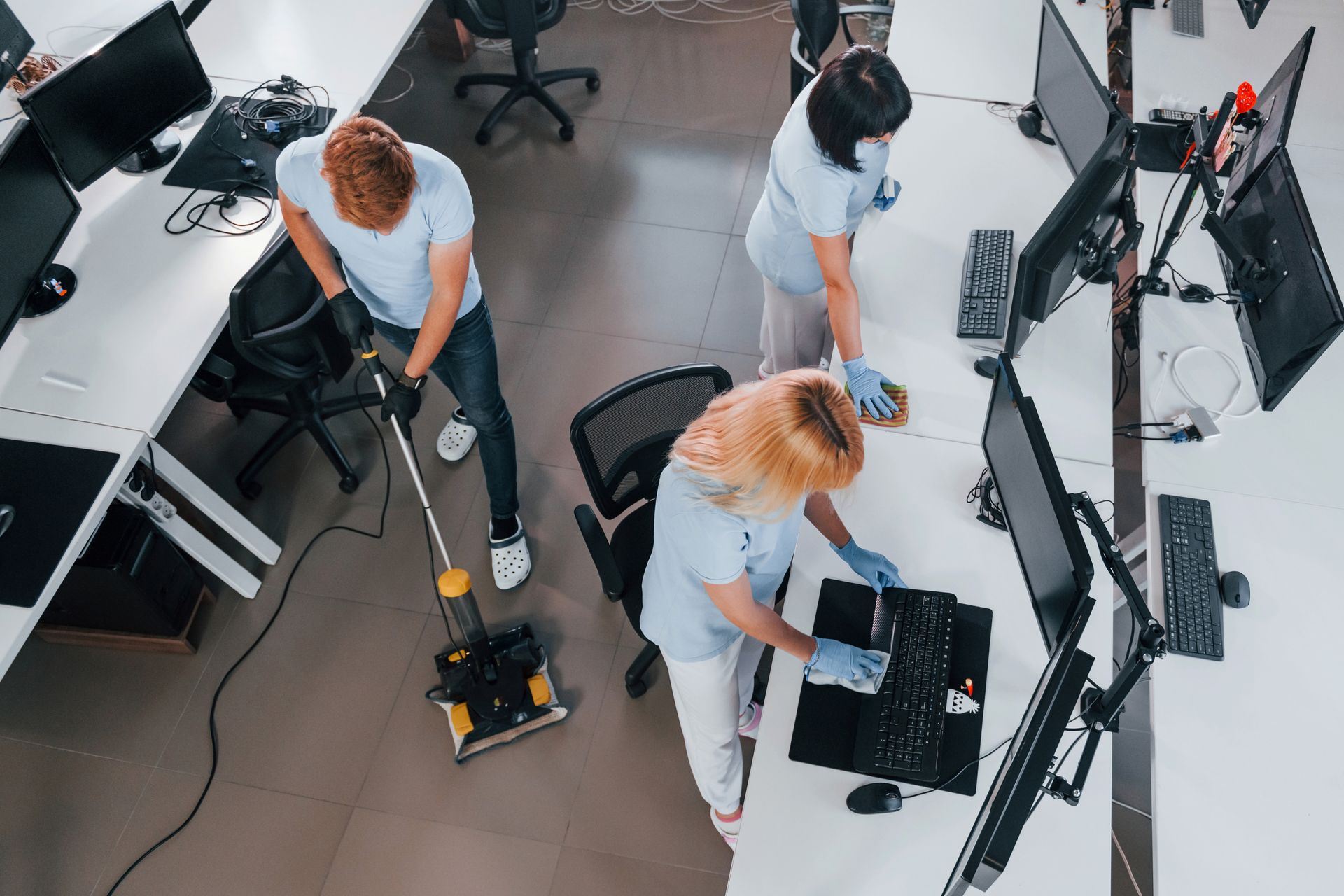
The professional version of deep cleaning generally includes hot water extraction or steam cleaning for carpets and upholstery, full disinfection of high-touch surfaces, vent and duct attention, floor stripping and waxing where needed, and a level of restroom sanitization that regular staff, understandably, do not want to be responsible for. There is dignity in delegation.
Why Not Just Do It Yourself, You Ask
You could. You could also perform your own dental work. Deep cleaning requires commercial-grade equipment, EPA-registered disinfectants used correctly (not "correctly" as in "I sprayed it and left the room fast"), and the specific stamina of someone who has decided, professionally, to look under the third-floor break room fridge without flinching. A trained janitorial crew does this efficiently, safely, and after hours, so your team walks in Monday to an office that smells like competence instead of eau de Tuesday's leftovers.
This also matters more than people think for actual outcomes: cleaner offices mean fewer sick days, better air quality, and employees who are not silently building a grudge against whoever left the mystery stain by the printer. A clean building is, in a very real sense, a functioning HR strategy.
The Part Where I Stop Joking
Look — your office building is where your employees spend roughly a third of their waking lives, and where your clients form their first impression of whether you have your act together. A deep clean isn't a luxury. It's basic maintenance for a space that's working harder than most people give it credit for.
That's the whole pitch, honestly. C&C Janitorial handles the parts of the building nobody wants to think about, so you don't have to develop a relationship with your break room fridge.
Your desk, on the other hand, remains your problem.
Check out some of our other blog posts...


The Office Cleaning Checklist for Athens, GA Businesses (Or: Why the Yogurt Is Plotting Against You)